Wednesday, October 20, 2010

Gaikokujin Tourokushou

Useful things for people studying abroad in Japan to know!

Always carry your passport with you until you get your Alien Registration Card (Gaikokujin Tourokushou) because it's entirely legal and encouraged for the policemen to ask to see the passport or alien card of anyone they believe to be a foreigner. In fact, I got stopped today in the train station and was asked to show my passport and Visa. You run the risk of being detained and even deported if the cops are in a bad mood, so keep it on you at ALL times. That being said, the Alien Registration Card is much more convenient and safer than carrying your passport (because replacing as lost passport quickly is hell, but the alien card is much easier). Only the passport or Alien Registration Card are acceptable forms of ID for foreigners--your school ID and other things won't be accepted.

To get the Alien Registration Card you'll need to go to the ward office of the ward you live in. You must go to the main large branch, not the smaller local branches in the ward. You'll need to bring your passport and two photos (4.5 cm x 3.5 cm). You'll also need to give your address of where you're staying in Japan, and fill out some paperwork (which conveniently has English translations) to submit it. Now, at that point tell them person behind the counter that you also need to apply for the National Health Insurance as well. In Japan, if you're here for more than 90 days (e.g. on an actual Visa and not the tourist Visa waiver) then you are REQUIRED to apply for this Alien Registration Card and the National Health Insurance. It doesn't matter if you have other insurance already--Japan doesn't care. Most doctors won't accept health insurance they don't recognize already, and some only take the National Health Insurance plan. So, apply for it because it's actually a good deal. For students with no income it's about $15 a month and covers 70% of all medical expenses while here, including dental. You can then take the remaining expenses and claim them from your own insurance when you get back home so in the end you may end up paying nothing.

You'll want to start this process early because it's a hassle and tempting fate to have your passport on you at all times. Also, make sure to go first thing in the morning right as the ward office opens because it gets really busy really fast. I got there before they opened and it still took a couple hours to get everything done and head home. They will give you proof of having applied for the alien card, but until you pick it up you still need to carry your passport at all times. It takes about 3 weeks to get it all processed and made after application. You should leave with your National Health Insurance Card the same day you apply for it and then you can immediately begin using it :)

So... who wants to see some dumb videos of me on a bus on the way to the ward office at freaking 7:30 am? Nobody? Well, I'm putting them up anyway! The first two links below are short bits of the bus ride to the huge Edogawa Ward Office in the morning, and kind of give you a feel for the other parts of Edogawa. The bottom link is a short excerpt from my 25 min walk to/from the train station everyday, while chatting with my dorm mate. We happen to live on one of the big highways in the Ward, so it's typically pretty busy. This was a fairly tame night, though. Not nearly as many people and bikes crowding the sidewalk.

Bus to Edogawa Ward Office
Walk Home

In other news, I went out and explored Shinjuku with a couple of Korean friends, and they took me to this awesome little noodle shop. The stuff is crazy-cheap and it's surrounded by the typical crazy Tokyo night life and bright lights.

Monday, October 18, 2010

Tea Ceremony

We got to be present for a short tea ceremony today before classes. It was really cool. The Japanese tea ceremony places emphasis on appreciating the simple beauty in things (the tea, the utensils used, the respective seasons when the ceremony is done play a role). After symbolically "purifying" ourselves We were taken to a traditional Japanese tatami room which was sparsely decorated. The alcove in the room showed something simple reflecting the fall season and some calligraphy along those lines. We sat and watched the woman make the tea, were given a traditional Japanese sweet in the shape of an autumn leaf, showed respect for the tea, and got to observe the simplicity inherent in it all. It was very calming--I may end up joining the tea ceremony co-curricular course because I think it's nifty.


In other news: photos!
The first is the much-loved, traditional Japanese "squatty potty" which always seems super weird to Westerners XD The second is... ICE CREAM. In a juice-box like container. HOW HAVE WE NOT THOUGHT OF THIS IN THE US?? You just twist off the top and suck the ice cream out of the package. It's so awesome. And delicious. I approve.

Saturday, October 16, 2010

Culture Course and Foodz

The US culture course seems like it's going to be interesting overall if today is any indication. The man teaching it seemed very into it, and that always makes it more interesting to learn. The topic was about the Japanese mentality/psychology, and that influence on Japanese culture. He made us play a little game: 7 people stood in in a circle, and first one person would step into the center and step back. Then two people. Then three. All the way until everyone was moving to the middle of the circle. The catch was we weren't allowed to speak to communicate or set up a "system" and instead had to rely on nonverbal clues. The interesting and relevant part comes when he explained how the Japanese students he coaches performed this exercise. Whereas we US students were more aggressive, made explicit eye contact to try to figure out who was going in, and actively searched for nonverbal cues the Japanese students instead used their periphery and tried to "read" the atmosphere of what everyone else was doing. Both the Japanese students and us had an equally difficult time not screwing up, but our methods for figuring it out were different, and he used that to accentuate the cultural differences. The Japanese are fairly adept at judging the "feel" of the group, and often function in a group-orientated fashion. This leads to a larger focus on the group rather than the individual. This is a direct reversal of how the US functions in which the emphasis is always on individuality rather than group harmony. He went a bit deeper than that brief summary, but it's a complex topic upon which dissertations can be written (and I've written papers on it, so there's a lot to it) but that's a good touch at the surface of the topic :)

Also! Dinner:
A whole cooked fish; some sort of... fried rice I think, with fish, egg and delicious things in it; salad; and soup. The fish was yummy but complicated to eat. You've got to pull the bits of meat from the fillet areas on both sides with your chopsticks, pull out the pin bones, and eat the meat. He was gutted before cooking, so you don't have to worry about that. The fried rice stuff was excellent, but I ended up having to ask the dorm manager lady to show me how to best eat the fish XD She gave a bit of a pitying look, but helped. Turned out to be that I was the only one signed up for dinner tonight so I ended up eating dinner with the dorm manager, her husband, and a woman that I assume is either her daughter or daughter-in-law.
Friday, October 15, 2010

First Normal Saturday Here

I've decided that Kinokuniya is currently my favorite store. It's a damn 8 story bookstore. All I can do is love it XD there's like an entire floor devoted to study stuff, and shit-tons of Japanese study material like rare textbooks, JLPT (the Japanese Language Proficiency Test) material, and hard-to-find grammar books. This shit is nigh impossible to find in the US, and you've got to import most of it/buy it online if you can find it all. Even then it's typically crazy expensive. I'm prolly gonna go back there today; I'll take some pics if I get a chance and it's not raining too badly. Because in Japan it always freaking rains.

Culture class for the US students begins today. I believe the topic is Japanese Psychology and Religions (I think) and it should be interesting overall. I've always liked that stuff, and have taken Japanese survey courses and history courses back at K-State state because it's such an interesting subject due to being fairly different from America in a lot of regards. The format for the class is typically lecture and mini activity, so it ought to be an interesting day.

Thursday, October 14, 2010

Weird Japanese Food

So, I just ate raw egg and what I think were little fish embryos... and you know what? I LIKED IT. At least, when I could disengage my brain from saying "You shouldn't eat that don't eat that OMG why are you eating that?!" it was good. It's a traditional Japanese breakfast, and pretty common from what I understand. You take the raw egg, beat it a bit with your chopsticks and then mix it into your hot bowl of rice. You can then pour a bit of soy sauce over it and it's pretty dang yummy. I thought the little fish things were like bean sprouts or something initially. I tried them and thought they were surprisingly delicious so I put a bunch in my bowl of rice with egg. I then brought the bowl up to my mouth to begin eating, looked at the bowl and stopped dead--They were little itty bitty fishies/fish embryos or something. And then I ate them anyway. Sadly, I didn't have my phone or camera on me to get a picture, but I can tell you while it's a bit disconcerting visually it's really good. If you can get over the pre-trained "Don't eat raw eggs" thing they push in the states, and shut your brain up you can enjoy it. Salmonella isn't common here, and they wouldn't serve it if it hugely unsafe (at least w/o some kind of warning lol). The dorm manager didn't seem to think I'd be able to eat the raw egg on rice, which of course meant I HAD to as a personal pride issue. She made me a softboiled egg just in case my American sensibilities got the better of me :P


Here's some other yummy stuff I've eaten over the past few days!


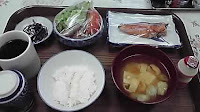
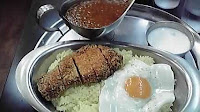
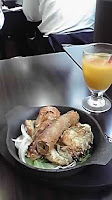
The first and second pictures are some delicious curry with chicken cutlet and meat tandoris, respectively. There's this really good--but tiny--curry shop near the school, and a group of us (6 in total) decided to try it out. It could barely fit all 6 of us, but the food was great. There was this little Indian guy speaking Japanese who made the food. It was made right in front of you, including the naan which was absolutely amazing. The curry isn't as spicy as I like though. That's just a Japan thing; things don't swing as far to the extremes as they do in the states. That is to say sweet things aren't a sweet as we're used to nor spicy things. The third picture is the other Japanese traditional breakfast I had a couple days ago. The typical Japanese breakfast nearly always consists of miso soup, rice, a meat, and some sort of salad/pseudo-salad thingy. This one happened to be a fish filet that morning. It was full of pin bones though, and I wasn't expecting that. I popped a big piece in my mouth and began to chew. Fun fun.

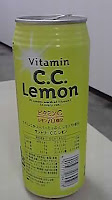
The last picture is my new favorite obsession drink-wise. It's called C.C. Lemon and I love it. It's more mild than lemonade, fizzy/carbonated, and has "The power of 70 lemons worth of vitamin C in every can!" (it says that on the other side of the can) which can only be good. I mean, who doesn't like vitamin C, right?

Sorry the pics are kinda fuzzy; I took them with my Japanese cell phone so the quality isn't as good as it could be.

Tuesday, October 12, 2010

Collection of Small Updates

Thought I'd put together a small update while I'm waiting for the cafeteria to open for breakfast (it doesn't open until 6:30 am, so I have about 15 min).

I experienced my first earthquake the other day. Don't freak out, it was a minor one; one of the kinds you won't even notice 99% of the time. I was laying down for bed so my room was quiet and I could hear things on my shelves shaking/rattling slightly. Small earthquakes are common in Japan, but ones you can actually feel are pretty rare, so there's nothing to worry about over all :)

I've decided I really like the train system. I don't like being squished butt to butt with random Japanese people, but I do like the trains. Experiencing the train system at rush hour is a pretty weird experience. The trains get so full that you don't even need to hold on to the handles because there's so many people pushed together that you're not in danger of falling over--you can't even move, really. But the trains are super quick and always on time. I don't even mind my commute to and from school. I have to take 2 trains, and I'm on each for about 20/25 minute so by the time I'm getting tired of being on the train it's time to switch trains and I'm fine :P

Classes started yesterday. I knew there were only going to be a few US/English-speaking people, but man, there are a lot of Koreans there. My class started with 4 US students in it (including me), and 2 of them are for sure going to drop down to the lower level. The other one is considering it but is going to try out this level a bit more. They seemed to be overwhelmed. I may end up being the only US person in my class, with the rest being Korean and like 2 Chinese guys.

Hmm, some details about classes are in order for those thinking about KCP. The classes are taught in what's called the "direct method" which means that class is only in Japanese and no other language is allowed. This makes sense if you think about it, because classes will be mixed nationalities so the only common language is Japanese. You're not allowed to bring a dictionary to class, or translation books in your native language, so it really forces you to start to think in Japanese. I happen to like this method, though I occasionally get lost in class trying to write things down and listen at the same time. Well, food is about to start. After that I've got some homework to finish up (I was already assigned 5 pages of it) and then it'll be back to class this afternoon!

Sunday, October 10, 2010

Cultural Thingies!

So, time for an update on some Japanese customs!

In Japan, it's incredibly important to be polite. There is often a double standard sort of thing; one thing is said but another is thought. But overall the outward appearance of properness and politeness is most important. Emphasis is placed on not inconveniencing others as much as possible, and showing the correct deference to those in a higher position than you. It can be small things, like not eating/drinking when walking or on a train (which is considered rude and substandard), or something bigger like the very way you speak. The Japanese language changes vastly upon whom you're talking to and what their relative position to you is. For example, my teachers speak in a casual manner to me, but I must be as polite as possible and not use the casual forms and verbs and such. It's a similar situation with my dorm manager. She speaks in a very casual manner with the short/contracted forms of verbs to me because she is both my dorm manager and an elderly lady, while I am a young student she is in charge of. I have to be really careful to reply in a polite manner, although she overlooks my slips because I'm still learning and not fluent. You speak politely to people you don't know well, even if they're on the same "level" as you, such as fellow students. People you know pretty well and your family you can address in a more casual manner. It's sometimes tough to figure out the proper politeness levels needed, but it seems to really impress the locals when you can judge the needs of the situation well or at all for that matter.


Personal update!

So, the place I went to yesterday called "Don Quijote" to get my cell phone is a damn crazy place. Think the loudness and musical insanity of an arcade, the variety of walmart, and then stuff that into the cramped maze-like space they have. I don't know what I was really expecting--some sort of Best Buy like thing, I guess--but I wasn't prepared quite for what I found. Once I adjusted it was actually really cool and very "Japan-like." This store was fairly close to the school, so I'd expected it to be an easy enough trip. Turns out I actually turned a block too early and wandered into the red-light district called Kabuki-cho. Getting lost isn't that difficult to do. Most of the streets in Japan aren't named except for the huge highway/high traffic streets; the addresses are based upon block numbers rather than street names. So, I can't really be too surprised that I accidentally meandered into Kabuki-cho. It's a fairly small area in Shinjuku, but the atmosphere is instantly different. You can feel how different it is just by walking by the edge. There are some... interesting-looking things around that are borderline legal at best. There are some hostclubs and stuff on the immediate edge. There's some yakuza activity in the area, and some seedy/unsavory things that go on there. I turned my ass around and walked back to the large street that I had come from. Kabuki-cho is not a place an alone foreign woman really wants to be, and it's not really that much better if you're in a group. If you don't know what you're doing and where you're going then you'll likely end up somewhere it would be better not to be. Tanaka-san said they've had issues with students getting into trouble in Kabuki-cho in the past, and I can understand that :P As curious as I may be, I'll have to settle for that skirting of the area; I'm not particularly inclined to tempt fate.